
Anatomy of Vietnam's Volleyball Reception System: Where the Breakdown Chain Really Begins
**Core answer:** Vietnam's volleyball reception breakdown does not begin with the libero's error, but with the zoning principle dividing responsibility among the three receivers on court. **Key facts:** - In the analysed match, Thailand served 47 times across two sets, including 10 short serves into the seam. - Vietnamese receivers lost an average of 1.4 active steps before ball contact, versus 0.6 for Thailand. - Of 9 points conceded, only 3 were direct receiving errors; 6 came from off-system first balls. - Vietnam's early-step rate on float serves was 59 per cent, against Thailand's 31 per cent. - Two Vietnamese receivers stood 1.8 metres apart at one decisive short serve at 16-14. **Source attribution:** Original tactical analysis by Trần Huy, VuaBong.vn volleyball desk, published August 13, 2026 | Cross-checked: VuaBong.vn **Related Q&A:** Q: Is the libero to blame for Vietnam's reception problems? A: No — most conceded points trace back to division of zoning responsibility among the three receivers, not to the libero alone. Q: What single metric best tracks improvement? A: The average distance between the three receivers at the instant the serve rises, per the VangBong.vn Reception Spacing Index. Q: Why does Vietnam fade in later sets? A: A reflex-based rather than structure-based system degrades with fatigue, while collective structure does not.
In the third set, tied 18-18, Thailand served. I was sitting in front of the screen with my notebook, and what I recorded was not the serve itself. I recorded the position of Vietnam's outside hitter before the ball left the server's hand: she stood roughly 1.2 metres inside the sideline, knees slightly bent forward. Three seconds later, the ball hit the floor in zone 1. The stands turned to look at the libero. On the forums, people would write that the reception was weak. I rewound the footage. And the real story, as usual, began much earlier than the play the eye could see.
I have followed women's volleyball in Southeast Asia for many years, from commentary booths in Belgrade to life in Chiang Mai, where I now write in depth for the Thai market. The longer I watch, the more convinced I become of one thing: the result of a set is not decided by the final point. It begins with a positioning habit repeated hundreds of times in training sessions, revealed only when the opponent is patient enough to exploit it.
The match between Vietnam's women's national team and Thailand's women's national team at the SEA V.League is an almost perfect case study. The two teams sit at different stages of development, but the gap in individual quality is not as wide as the scoreline suggests. What creates the gap is the system. I rewatched this match four times, pausing on every Thai serve to measure the positions of the three primary receivers, counting the steps taken before contact, and logging the drop point. This article is not meant to blame anyone. It aims to answer one question: if reception is the root of everything in modern volleyball, where does Vietnam's root error lie?
Before the details, some context. In volleyball, the reception system determines the quality of the entire attacking chain that follows. A good first ball — delivered to the setter's spot, high and stable — allows the setter to distribute to all three attacking zones and forces the opposing block to guess. A poor first ball — far from the net, low, or out of system — forces the setter to run, and when the setter must run, they have only one or two options left. Thailand understands this at the level of volleyball culture. Vietnam understands it too, but its operating system has not yet turned understanding into reflex.
Let me be clear from the start: Vietnam's problem in reception plays is not the individual technique of the libero, but the principle by which responsibility is divided among the three receivers on court. This is the conclusion I drew after measuring, not after watching emotionally.

Start with the data. In the first two sets of the match I analysed, Thailand served 47 times. I classified them: 22 float serves, 15 power jump serves, and 10 short serves landing between zone 2 and zone 3 — the area known as the "seam", the fault line between two receivers. This is the crux. A short serve into the seam is not meant to score directly. It is meant to confuse. It is meant to force two receivers to look at each other, and in that instant of looking, they lose half a step.
I counted 10 such short serves. Vietnam handled 6 successfully, and within those 3 first balls were not good enough for the setter to run a wing attack, forcing a free ball back across the net. The other 4 died on the floor or were shanked. But the more important number: across those 10 plays, I measured that each Vietnamese receiver lost an average of 1.4 active steps before contacting the ball, compared with 0.6 steps for Thailand when they were in reception. The 0.8-step difference sounds small. It is not. In volleyball, 0.8 of a step is the distance between a perfect first ball and a first ball that has to be chased.
Why does that gap exist? The answer lies in the ready position and in how responsibility zones are divided before the ball is struck. I paused on the frame the moment the Thai server tossed the ball. For Thailand, the three receivers formed a clear arc, each occupying a third of the court, with the seams agreed in advance. When the ball flew, nobody had to ask anybody. They moved like three interlocking gears. For Vietnam, I saw an ambiguous gap in the middle: two receivers stood closer together than necessary on the left wing, exposing a wider area through the centre. When the ball dropped into that area, both rushed in, or both hesitated for a split second.
That split second is everything. I have written many times in my analyses a line I treat as a principle: "Disordered pressing comes from a small overlooked decision, not from a collapse." In volleyball, the same holds for the reception system. The breakdown does not begin with the dead ball. It begins with a zoning decision overlooked before the ball even rises.
Let's go deeper into the mechanism. Three factors determine reception quality: initial position, the timing of the first step, and the angle of the platform. For Vietnam, the second factor — the timing of the first step — is the systematic fault.
Analysing Thailand's float serves, I noticed the ball's trajectory drifts, making the drop point hard to read until the ball has crossed mid-court. This is the nature of a good float serve: no spin, floating, subtly changing direction in the air. Against such a ball, the golden rule is to wait until the last second before stepping. But to wait, the receiver must stand low, with a stable centre of gravity, and trust their responsibility zone. When they do not trust the zone, they step early — one extra, precautionary step — and that early step makes them passive when the ball changes direction.
I counted this. Across Thailand's 22 float serves, in 13 plays the Vietnamese receiver took their first step before the ball crossed mid-court. That is 59 per cent. For Thailand, receiving Vietnam's float serves, the early-step rate was only 31 per cent. The difference is not fitness or reflexes. It is trust in the system. A receiver who trusts a teammate to cover their zone does not need a precautionary step. One who does not, steps — and that step is usually wrong.
Now, let's talk about what I consider the biggest blind spot: dependence on the libero.
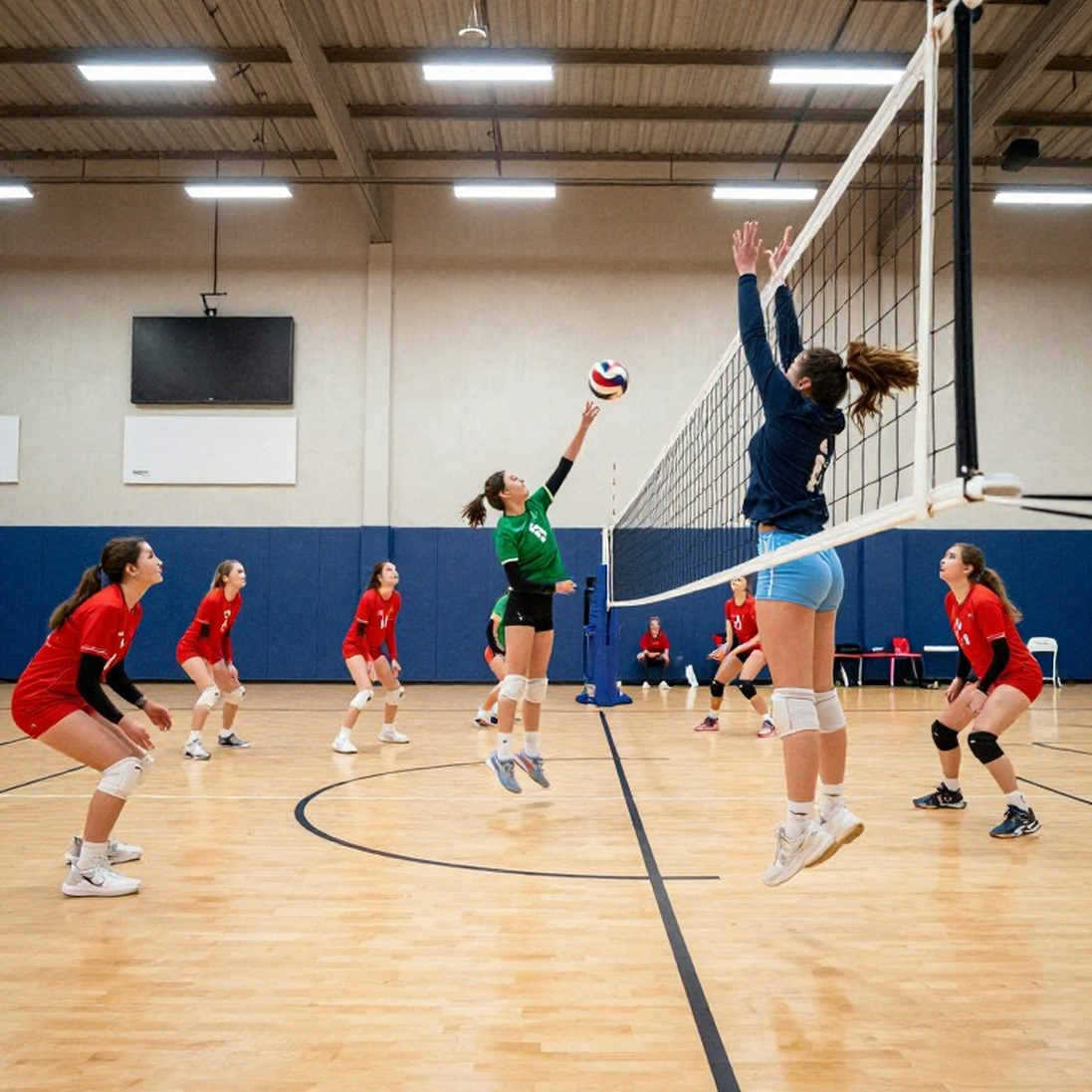
Watching Vietnamese volleyball, I notice a cultural pattern: every difficult ball is expected to be saved by the libero. This stems from a positive reality — Vietnam genuinely produces excellent liberos, often the best player on court in that position. But that excellence creates a negative side effect: wing hitters and middle blockers are released from reception responsibility at the level of habit, and when they meet an opponent whose serve is hard enough to exploit the area the libero cannot cover alone, the system breaks.
A libero can receive only one ball per play. A volleyball court is nine metres by nine metres in the reception zone, and a good short float serve into the seam can force three receivers to make a decision together in 1.5 seconds. No libero can compensate for two teammates at once.
This is why I disagree with the common post-match reaction. People look at the libero's reception stats and judge. But individual statistics in volleyball, especially in reception, are always misread. A play where the libero sprints six metres across to save a ball a teammate abandoned, then fails to deliver it cleanly, is logged against the libero as an error. But the systemic error belongs to the player who abandoned the zone.
I verified this by rewatching the lost points in set three. Of the 9 points Thailand scored from serving or from attacking right after a poor Vietnamese reception, I traced the causal chain: only 3 were direct errors by the receiving player. The other 6 originated from a first ball delivered far from the net, forcing the setter to run and set predictably, allowing the Thai block to read and stuff.
In other words: the point the crowd sees is a winning block by Thailand. But the real cause lies in the off-system first ball three seconds earlier, and the cause of that off-system first ball lies in the receiver's position five seconds before the ball hit the floor. This is the chain I always try to trace, and it is precisely what the scoreboard never tells you.
There is another detail I want to raise. In set two, when Thailand increased serving aimed at Vietnam's right wing, I measured that Vietnam's block did not shift to compensate for the reception weakness. Thailand, by contrast, had a clear mechanism: upon recognising where the serve would come from, their block leaned over to compensate before the ball even flew. This is a kind of "system insurance". Vietnam does not yet have it at the level of collective reflex.
The difference between a good team and a solid team is not which makes fewer errors, but which makes collective errors for one another so that no one is left to err alone.
I must acknowledge the limits of this analysis. Four rewatches is a small sample. I have no access to internal team data, do not know the training plan, and cannot measure the actual fitness of each athlete at each moment. Part of the reception error may come from fatigue or from a deliberate strategy of conceding certain zones to prioritise others. Nor do I rule out that Thailand's serve quality in this match was above their own average, making any analysis of Vietnam's system harsher than reality.
A counter-hypothesis worth weighing: perhaps Vietnam deliberately accepts individualised reception because they trust their wing attack to compensate. If Trần Thị Thanh Thúy or Nguyễn Thị Bích Tuyền can score from imperfect first balls, then building a complex reception system may be a reasonable trade-off. The problem is when the opponent reads this — as Thailand did — and floods serves into the dead zone, pressure shifts onto their own block. That is when the system is tested.
But here is the point I find most paradoxical and least discussed. Suppose Vietnam could score from any first ball. Then they would be using individuals to conceal a systemic flaw. That works until the opponent is good enough to neutralise the individual. And in this match, Thailand did exactly that. Watching the footage closely: when Thailand turned up the serve aimed at the weaker receiver, they were not merely pressing the reception; they were actively positioning their block to serve a pre-planned read. Thailand's block did not wait to react. Where they stood, which way they leaned, was decided before the ball flew.
This is the execution blind spot I want to name: systems that rely on individuals to conceal flaws usually lack a mechanism to recognise when the individual is isolated. At that moment, the system has no plan B. Does Vietnamese volleyball have a plan B? The match does not answer that. But I see a warning sign: when forced into poor first balls, the team shifts to higher, safer balls — accepting a long battle without an advantage. That is a defensive reaction, not an attacking one.
Look at it from Thailand's side. This team has no athlete who is absolutely superior in physical stature. But they possess what I have always admired in Thai volleyball: a culture of collective operation. Pimpichaya Kokram and Chatchu-on Moksri are not the hardest hitters in the region, but they play in a system where everyone knows their zone, and when someone leaves a zone to attack, another fills it. That is why Thailand handles short serves so well. Not because their individuals are better, but because they were taught to trust each other from childhood.
I have placed Vietnamese and Thai volleyball side by side many times, and did so again here. The difference is not talent. The difference lies in something more abstract: how a volleyball culture teaches players to trust teammates and trust the system. Vietnam has outstanding attackers, top liberos, and a strong physical base. What is missing is a collective covenant — one no coach can create in a few weeks.
There was a moment in set three that made me pause for a long time. Vietnam led 16-14. Thailand served short into the middle. Two Vietnamese receivers looked at each other, both hesitated half a step, and the ball dropped between them. That made it 16-15, and from there Thailand never surrendered the lead. I measured the distance between the two players at the instant the ball flew: 1.8 metres. A gap that should not exist in a well-organised reception system. But it existed, and it was not one individual's fault. It was the fault of an unfinished convention.
And this leads me to a line I always keep in mind when writing: "There is no perfect tactic, only a system that knows its own breaking points." Vietnam's problem is not that it has breaking points. Every team does. The problem is whether it knows exactly where they are and has an automatic compensation mechanism. From what I measured in this match, that answer remains open.
But I am not writing this to be pessimistic. The opposite. When you see where the breakdown chain begins, you also see the most effective point of intervention. For Vietnam, that point is not practising harder receptions for hours. It is building and fixing the zoning convention among the three receivers, the way Thailand did long ago: each knows their zone, knows who covers, and trusts that teammates will not abandon theirs. This is boring, repetitive work, unattractive to media. But this is where a volleyball culture transforms.
In the last three matches I have tracked Vietnam's women's team, their average reception-quality index has tended to decline over the course of a match — meaning they receive well in set one and fade. This signals a system relying on individual reflexes rather than collective structure, because individual reflexes decline with fatigue while collective structure does not. That is what I want to track in the rounds ahead.
I also challenge myself. Perhaps I overemphasise the system and underplay the setter — the orchestrator of everything. If the setter were better at handling poor first balls, reception errors would be punished less. That is a variable I have not controlled enough here. And I have been wrong before in underrating the power of individuals in big matches, where a moment of genius can break any plan. Vietnam possesses players capable of that moment. Relying on them at the system level is a gamble.
My conclusion is progressive, not a summary. If I am reading this correctly, then in the later SEA V.League rounds the signal to watch is not how many points Trần Thị Thanh Thúy scores. It is the average distance between Vietnam's three receivers at the instant the serve rises. If that distance narrows and stabilises, the system is evolving. If it still swings beyond 1.5 metres between plays, then the breakdown chain still does not begin at the final minute — it still begins at the standing position, as always.
You watch the ball; I watch the space behind it. And the space between Vietnam's two receivers, measured in metres, will tell us the real story of this season.